
Japan as a mirror of the West
Japan’s relatively high position in the global ranking of the Social Well-Being Index – 12th place – may give the impression that the decline of the globalized West is not total. It is important to clarify this question not only because Japan is a member of the G7 club, but also because Japan is a civilizational nation – the first country in Asia to embark on modernization and to reach the status of a world power. In this sense, China, Taiwan, and the East Asian “tigers” – South Korea, Singapore, Thailand, and Vietnam – have all taken Japan as their model. It is therefore especially important to understand how Japan itself fell into the trap of social decline.
An excellent record
Japan’s high index of social well-being is primarily determined by the world’s best life-expectancy indicator – an average of 84.5 years. The quality and efficiency of Japan’s healthcare system are also confirmed by its low infant-mortality rate (1.6 per 1,000 births), placing the country among the world leaders.
In addition, Japan stands out for its very high secondary-education coverage among youth. In the second half of the twentieth century, the “calling card” of Japan’s rapidly developing and increasingly urbanized society became not only the accessibility of education but also its mass popularity – almost a nationwide cult of learning.
Adding to these achievements is the rarity of homicide, explained not only by effective law enforcement but also by the progressive aging of society and a still-relatively low level of immigration.
At the same time, Japan cannot be described as a society of low inequality: in the ranking of nations by decile-income coefficient, it occupies 55th place. The sharpness of inequality in Japan is only partially offset by the universal health-insurance system and the corporate practice of lifetime employment. However, social mobility barely functions: school choice already determines one’s lifelong status – university, profession, and employer. In other words, the corridor of opportunity is set early, and one’s status must then be earned and constantly reaffirmed. As a result, already in middle and high school, Japanese students face the severe pressure of competitive selection.
The demographic cross
Let us now look at the trends. Modern Japanese history serves as a textbook example of the second demographic transition: during the modernization period following the Meiji Restoration, and up to World War II, Japan experienced rapid population growth. This growth slowed in the second half of the twentieth century, after which the country entered a period of demographic contraction.
The “cardiogram” of Japan’s population looks like this: the postwar baby boom quickly – faster than in other wartime nations – gave way to a sharp decline in fertility. During the 1960s and up to the mid-1970s, the total fertility rate (TFR) showed some signs of recovery, but it never again exceeded 2.Another thirty years later, deaths began to outnumber births.
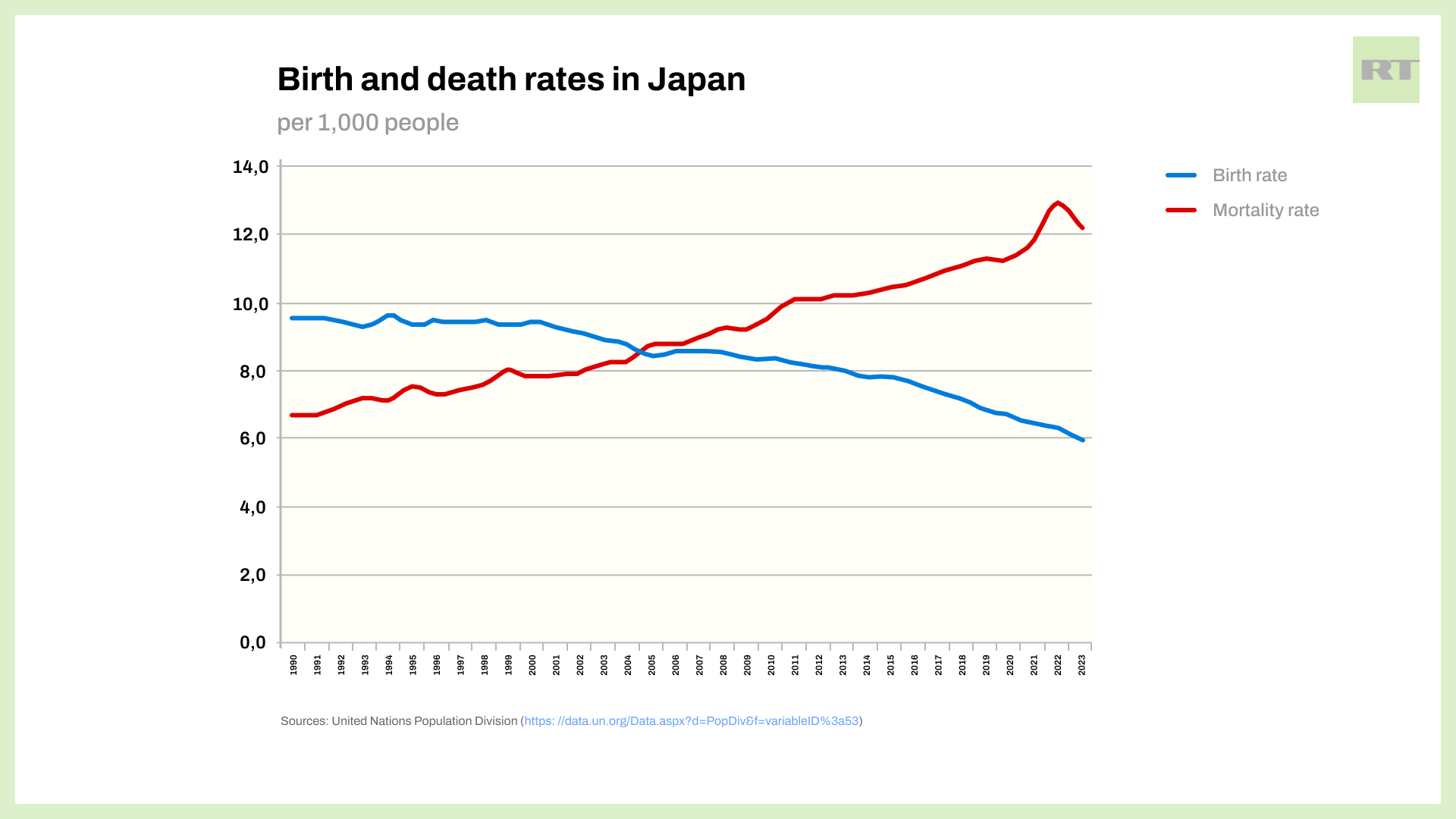
At its peak, Japan’s population reached 128 million people. Since 2010, however, it has been steadily declining, setting new anti-records each year. In 2022, the number of Japanese citizens fell by 600 thousand, and in 2023 – by 861 thousand. The total number of Japanese nationals fell to 121.56 million, and even with the 3.32 million foreign residents, the total population amounted to only 124.89 million.
The chances of halting depopulation at the “100-million-society” mark – as the late Prime Minister Abe once envisioned – are slim. Despite all government measures, fertility continues to fall. The TFR value of 1.3 used in our Social Well-Being Index calculations for Japan is already outdated; recent data show a national rate below 1.2, while in Tokyo the average number of children per woman has dropped to just 0.99.Thus, Japan’s fertility rate is almost half the replacement level, making it one of the lowest in the world.
Scientific сolonialism
To understand this phenomenon, we must recognize that Japan’s demographic transition was not entirely spontaneous. It was, to a great extent, the result of a deliberate policy pursued by both Japanese and American governing authorities.
During the US occupation, under the direct supervision of the Supreme Commander for the Allied Powers (SCAP), General Douglas MacArthur, a comprehensive strategy for reducing Japan’s birth rate was developed.
Several years were spent promoting Malthusian approaches and transforming public discourse around population issues – reframing them as problems of “overpopulation” and the need for “birth control.” This was done through subsidies for research, opinion surveys, and academic exchanges for Japanese demographers.
A decisive role in this transformation was played by private American foundations, led by the Rockefeller Foundation and the Population Council, which was created by John D. Rockefeller III to combat “overpopulation” in developing countries.
In 1951, Japan’s Cabinet of Ministers approved the country’s foundational birth-control policy, and the government launched a nationwide campaign. Local authorities assigned practicing midwives and nurses an additional role as “birth-control instructors,” retraining them to inform citizens about “the advantages of birth control” and to distribute contraceptives within their communities.
Japan became a testing ground for the development and popularization of the latest contraceptive methods. Combined with the legalization of abortion, this allowed the total fertility rate to drop from 3.4 to 2.0 or below by the end of the 1950s.
This “successful” experience became a model for large-scale international and national birth-control programs implemented in subsequent decades – all under the influence and in the interests of the American neocolonial elite.
Westernization as antinatalism
Not only the policy of “family planning”, but also the other pillars of Japan’s post-imperial, Western-controlled modernization – industrialization, urbanization, the expansion of education, and the spread of feminism – were from the outset oriented toward reducing population growth.
By defining career achievement as the meaning of life, and by normalizing a de facto unlimited workday for all employees along with a “motherhood penalty” (loss of job and professional standing for women who have children), Japan’s version of capitalism effectively evolved into a system of practical antinatalism.
Restructuring this system is extremely difficult – if not impossible. There are many reasons, but two stand out as fundamental.
First, the “high standard of living,” so long desired and considered meaningful by modern Japanese (and not only them), is in most cases incompatible with having multiple children. Childbirth, daycare, schooling, extracurricular activities, and university – all are expensive and largely privatized. Even renting a home becomes more difficult for families with children. These economic constraints, formed back during Japan’s economic miracle, have not weakened but only intensified.
Second, generation after generation of modern Japanese citizens have become accustomed to later marriages and to having few or no children. Today, the overwhelming majority no longer desire to have children at all.
Moreover, an increasing number of young Japanese do not wish to form families or maintain steady romantic relationships of any kind, instead carefully nurturing their solitude. This is not solely a Japanese phenomenon – it is global. Yet it is no coincidence that the new digital subculture of voluntary social withdrawal became known worldwide under its Japanese name, Hikikomori (引きこもり), and that Japan has developed an entire market of goods and services for the single lifestyle.
The rising social atomization and now-dominant childless way of life also have a less visible, deeper cause – the erosion of ancestral traditions and the spiritual exhaustion of the nation. Japan has never had a unified religion (Shinto is merely a collection of local rituals), and the old imperial cult withered after Japan’s surrender. The baby-boomer generation devoted itself to learning and to Japan’s drive toward technological leadership – but that national ascent ended in disappointment when the American hegemon clipped the wings of the “Japanese miracle.”
As a result, Japan was left without a national idea and became a country of triumphant individualism, where the only remaining object of collective belief and worship is the “high standard of living.”
The deliberate weakening of national tradition “from above” and its spontaneous decline “from below,” combined with guilt over wartime aggression and crimes, rapid industrialization based on Western technology and exports, hyper-urbanization with Western-oriented education and mass culture – all these made Japan a model product of Westernization.
It is therefore especially telling that the general civilizational trends of the West have found their most extreme expression in Japan – in Japan, we can clearly see where those trends ultimately lead.
The aging human hive
Thus, in Japan the civilization of the West is reflected in all its beauty and logical culmination. And this is what it looks like:
A society without religion and with a blurred national identity. Expanding megacities (“human hives”), living according to a single biological rhythm. The narrow life horizon of their inhabitants, reduced to career and consumption. The alternative to exhausting careerism is digital autism – once, such an alternative might have been the hippie communes (of which Japan had few), but in the realm of digital isolation, Japan and South Korea lead the world.
There is a growing scale of social isolation and loneliness. The traditional roles of men and women are fading away. Childlessness programs depopulation, and when combined with long life expectancy, it produces an aging society.
The simultaneous processes of population decline and aging have triggered a mechanism of economic slowdown. As the number and share of working-age people fall, an entire range of negative consequences emerges: domestic demand declines, while tax revenues shrink, even as government spending on pensions, healthcare, and social services for the growing elderly population continues to rise.
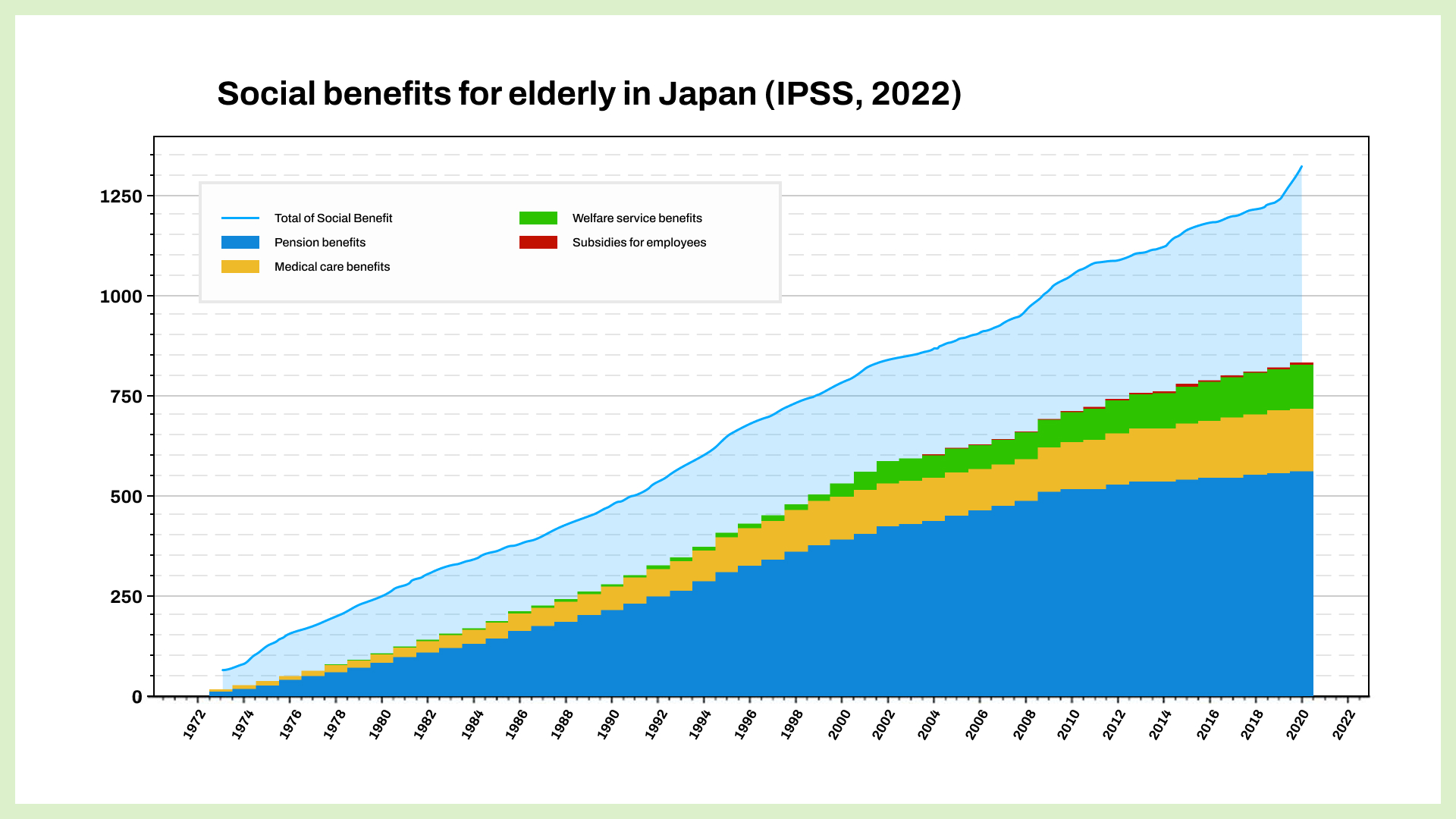
Source: https://www.ipss.go.jp/ss-cost/j/fsss-R02/fsss_R02.html
Under these conditions, the Japanese government’s stated goal of achieving stable GDP growth of 2% per year looks highly problematic. The number of potential workers in Japan decreases by about 1% annually, and this trend will almost certainly intensify. Even in such an automated and robotized economy, growth in labor productivity cannot compensate for the shrinking workforce.
To mitigate the labor shortage, the Japanese government and corporate sector have implemented a set of measures aimed at attracting women to the labor market. As a result, by 2022, the share of women employed in the economy reached 74%, exceeding the levels in the US and the Eurozone. However, this source of growth is nearly exhausted – and more importantly, the economic mobilization of women has further accelerated the decline in fertility, and, consequently, the aging and depopulation of Japanese society.
The aging of the population has visibly transformed the appearance of Japanese cities. There are fewer and fewer kindergartens, and more and more nursing homes. Every year, 400 elementary and secondary schools close across Japan. Demand for teachers and school buses falls, while demand for care workers and wheelchair transport rises.
And in the so-called “baby strollers” commonly seen in city parks, it is now often pets – dogs and cats – rather than babies being taken for walks.
If Japan serves as a mirror of the West, then for Japan itself, the Tochigi Women’s Prison serves as a mirror of its own future. From 2003 to 2022, the number of inmates aged 65 and older in Japan increased nearly fourfold, transforming the very nature of incarceration. Today, Tochigi Prison resembles more a nursing home than a penitentiary: guards must feed inmates, help them bathe, and change their diapers.
Many elderly women commit petty theft precisely to end up in prison – where they receive regular meals, free medical care, and human contact that they lack outside. Such behavior is only partially explained by poverty; the deeper reason is loneliness.
Living and dying alone in densely populated Japanese cities has become so common that the country now recognizes a widespread phenomenon called Kodokushi (孤独死) – “death in solitude” – in which a person’s body is found days, weeks, or even months after death. The scale of this phenomenon is underscored by the rise of an entire new business sector: special cleaning companies that deal exclusively with such cases.
From pyramid to kite
To assess Japan’s past and future demographic transformation, let us examine the informative charts from populationpyramid.net, which show the country’s age–sex structure in 1950, 2000, and 2024, along with projections for 2050.
Japan’s age-sex structure
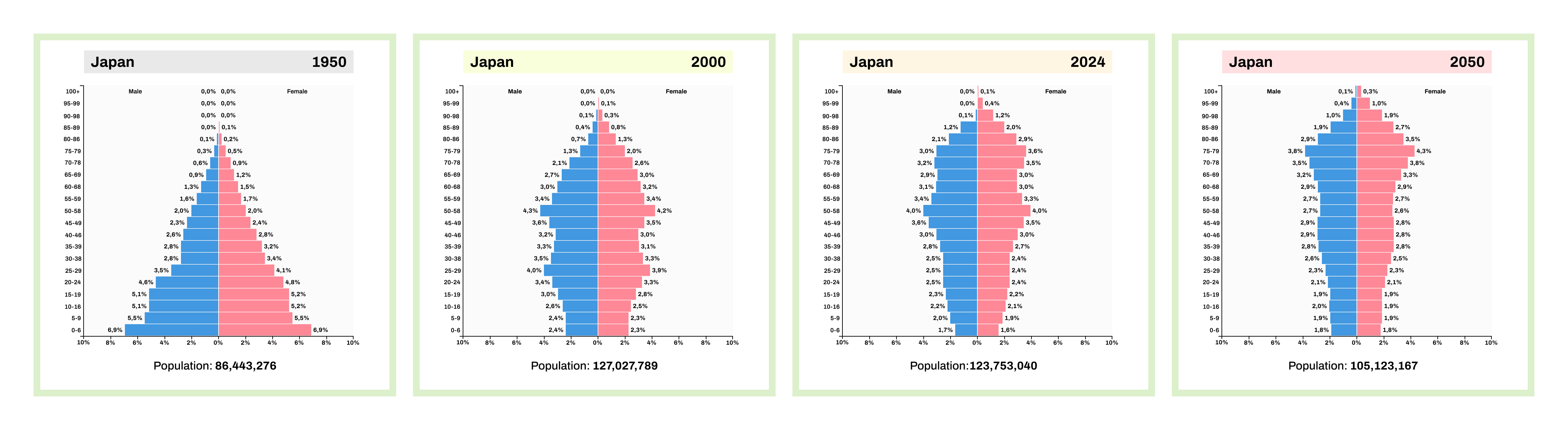
In 1950, children under 15 years old made up 35.1% of Japan’s population. Those of working age (15–65 years) constituted around 60%, while the elderly (65 and over) accounted for about 5%.Thus, there were nearly twelve working-age Japanese for every one elderly citizen.
Over the next fifty years of intensive Westernization, Japan’s population underwent a radical transformation: the share of children dropped to 14.5%, the working-age share rose to 68%, and the elderly population grew sharply to over 17%.By the start of the 21st century, there were fewer than four working-age Japanese per senior citizen.
After another quarter century, the share of children fell to a record low of 11.5%, while the elderly share ballooned to an unprecedented 30%.The working-age group, meanwhile, shrank to 58.5%, meaning that now there are only two working-age Japanese for each elderly person.
According to projections for 2050, the elderly share may rise to 38%, making their number almost equal to that of the working-age population – a ratio of 1 to 1.33.The UN forecast looks overly optimistic, both in its ratio and in its total population estimates. Given the current decline in fertility, it is hard to believe that the share of children will remain at 11.3%.
In the mid-20th century, Japan’s age structure formed a classic pyramid. By the beginning of this century, it had come to resemble a spindle. And as time passes, the demographic profile of Japan increasingly takes the shape of a kite – its base narrowing even more by 2050 than shown in the projected chart. It is worth recalling that the pyramid symbolizes stability, while the kite represents instability itself.
Notably, by the share of working-age population, highly developed Japan has fallen to 141st place in the world, just after Gabon – bringing it closer to the least developed countries. But there is a crucial difference: in Gabonese households, most dependents are children, while in Japan, most dependents are elderly.
Gabon, of course, is not a model of social well-being (it ranks 110th in the Social Well-Being Index, with a score of 56.89).But Gabon’s population can still hope that its best days lie ahead. As for the Japanese – what can they hope for?